
Tradition
Why We Are Called the Modern-day Musashi
Miyamoto Musashi and Yagyū Munenori — the founder of the Edo Yagyū Shinkage-ryū from which our school descends — were contemporaries who never crossed swords. So how did a Yagyū-line dojo in Kyoto come to be known by Musashi’s name? A short history of the two-sword style, and the swordsman who carries that name today.
When visitors first hear of Yushinkan, the name they most often remember is the Modern-day Musashi. It is a striking title — and one that, for many, raises a quiet question. We come from the Yagyū Shinkage-ryū lineage. So why are we associated with Miyamoto Musashi, who never trained in that school at all?
The answer reaches back four centuries, into the early Edo period.
The Sword Saint of Two Heavens
Miyamoto Musashi (c. 1584 – 1645) is one of the most celebrated swordsmen in Japanese history — a kensei (sword saint) whose record of more than sixty undefeated duels shaped the legend that surrounds him today. Around the age of twenty-one, Musashi began developing a style that would become his signature: wielding the long sword (katana) in one hand and the short sword (wakizashi) in the other, fighting with a blade in each hand simultaneously. He named this school Niten Ichi-ryū (二天一流) — “the school of two heavens as one.”
His reasoning was practical. A sword held in two hands, Musashi argued, has limited freedom — it cannot easily reach to either side, and it is unwieldy on horseback. By splitting katana and wakizashi between two hands, the swordsman gains range, balance, and decisiveness. In Musashi’s hands, this became a way of fighting; in his writings, a way of thinking. In his final years, retired to a cave in Kyushu, he set down his philosophy in The Book of Five Rings (五輪書) — a text on swordsmanship and strategy still read worldwide today.

A Historical Paradox
Few people realize that Musashi was, in fact, a contemporary of Yagyū Munenori — the founder of the Edo Yagyū Shinkage-ryū from which our own school descends. They lived in the same Japan, walked the same roads, and yet were almost diametrically opposite kinds of swordsmen.
Munenori served the Tokugawa shogunate as the official sword instructor and as ōmetsuke (Inspector General) — a position close to that of an intelligence chief. His art was the sword of the political body: strategic, restrained, and rooted in a philosophy of katsujinken — the “life-giving sword,” in which the highest aim is to resolve conflict without unnecessary violence. Munenori’s own treatise, the Heihō Kadensho, fused Zen Buddhism with swordsmanship and became one of the foundational texts of Japanese martial philosophy.
Musashi, by contrast, was a wandering rōnin. He held no position, served no lord for long, and traveled Japan in pursuit of the duel.
There is a famous account of Musashi arriving in Edo and requesting a match with Munenori. Munenori is said to have declined, replying with a letter — and a single cut flower placed alongside it. Musashi left Edo and never again sought him out. The two streams of Japanese swordsmanship — the Yagyū tradition and the Musashi tradition — remained separate. One was the sword of the political body; the other, the sword of the lone path.
Why “Modern-day Musashi”
The school Yushin-sensei represents — Yushin-Ryu — descends from the Yagyū Shinkage-ryū side of that history. The kata, the philosophy, and the disciplines that run through Yushinkan are rooted in the Yagyū tradition, carried forward by generations of dedicated practitioners to the dojo we run today.
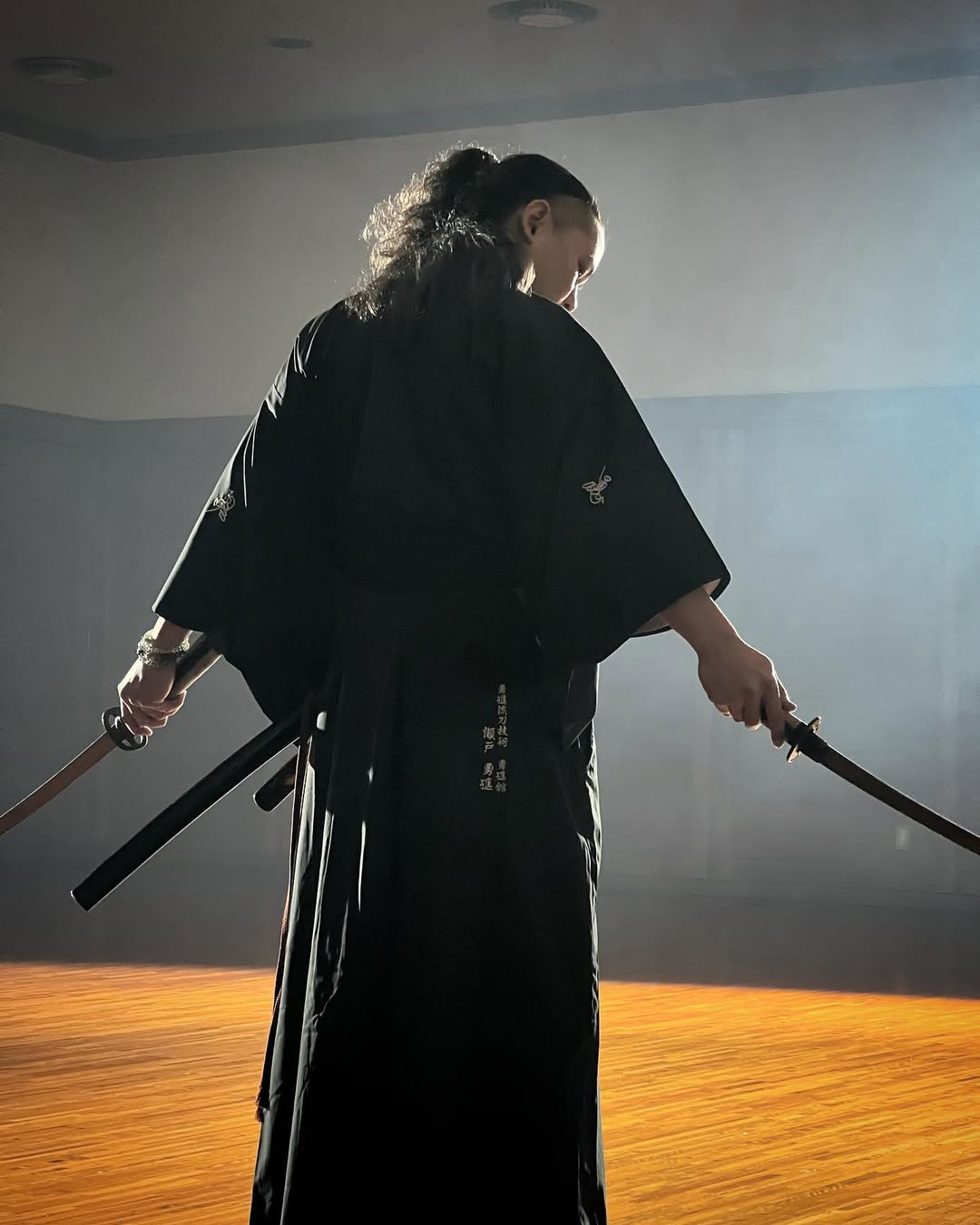
What sets Yushin-sensei apart, personally, is something else: he is also widely known as a master of nito — the two-sword technique most closely associated with Musashi himself. Holding both katana and wakizashi at full speed, moving each blade with the precision of a single weapon, is rare even among lifelong swordsmen.
Yushin-sensei performing nito tameshigiri at Yushinkan
It is this — Yushin-sensei’s personal mastery of the two-sword art, set against the backdrop of his Yagyū-rooted lineage — that earned him his name as the Modern-day Musashi. Not because the school descends from Musashi (it does not), and not because nito is part of our school’s transmission, but because in one swordsman, today, the two figures who once shaped Edo-era Japan can both be quietly recognized.
Further Reading
- The Book of Five Rings (五輪書) — Miyamoto Musashi’s late-life treatise on strategy, written in his retreat cave at Reigandō.
- Heihō Kadensho (兵法家伝書) — Yagyū Munenori’s foundational text fusing Zen and swordsmanship, the philosophical bedrock of the lineage we descend from.
About this article
This is a deeper companion piece to our main page on the Yushin-Ryu lineage. If you are new to the school, that page is the better place to start.

この記事へのトラックバックはありません。