
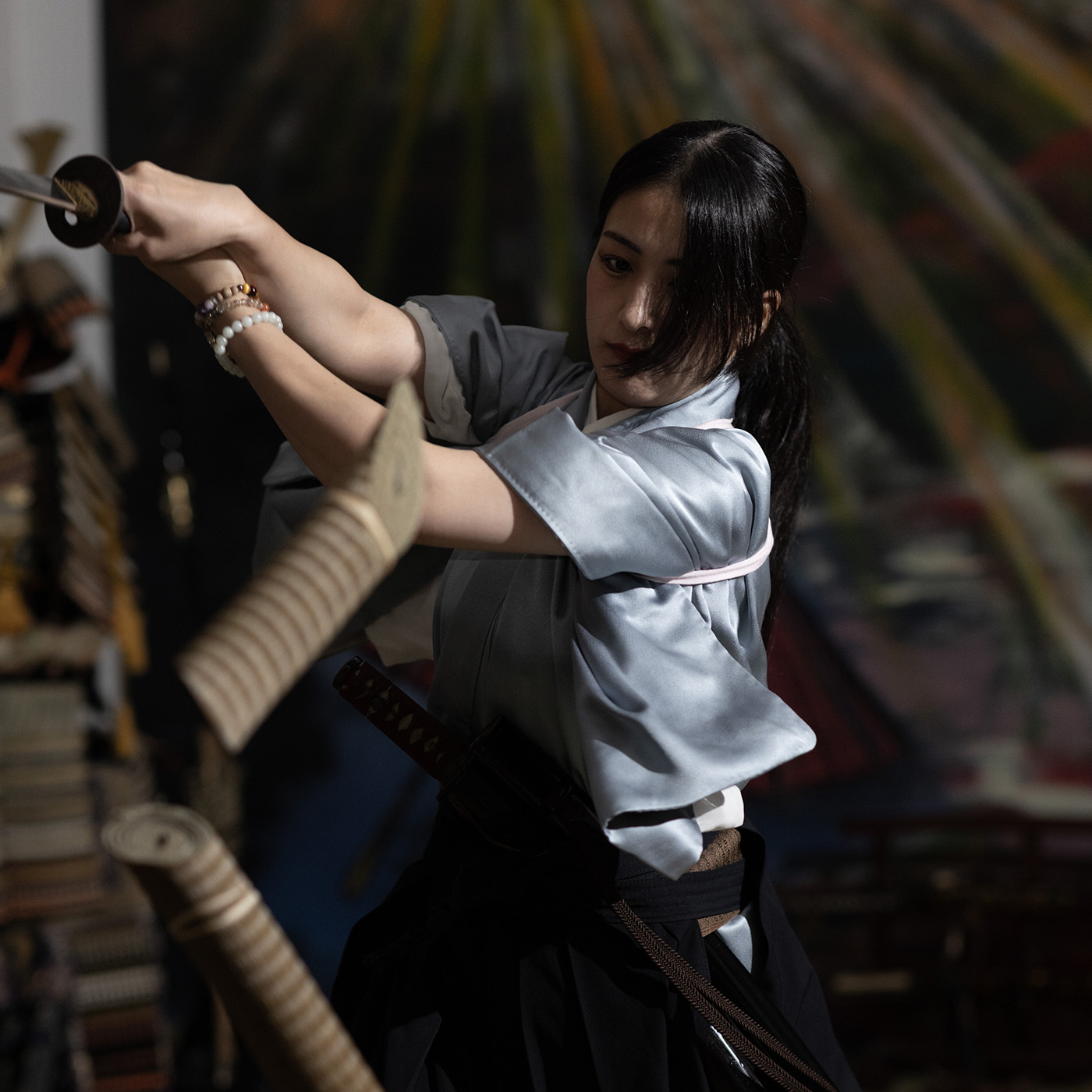
Hello, and thank you for stopping by. I am Kaguya from Yushinkan Kyoto, home of Samurai Training with the Modern-day Musashi.
When people picture a “samurai cut,” they imagine a blade slicing cleanly through a target in a single, effortless motion. That is tameshigiri – test cutting – and it is one of the most striking things to witness in person. Below, our instructors demonstrate a range of real cutting forms, each with its own name, rhythm, and purpose. Watch how different a true cut looks from one technique to the next.
One note before we begin: every cut here is performed by our trained instructors, including our master, Yushin-sensei, and Osayo. At the dojo, visitors learn these forms as kata using a blunt practice sword – live cutting is a demonstration, not a tourist stunt. We explain why that distinction matters near the bottom of the page.
The Six Basic Cuts (Kihon Roku-to)
Before any of the flashier techniques, every student begins here: the fundamental cutting angles that form the foundation of everything else. Master these, and the rest becomes possible.
Named Cutting Forms
From there, the forms grow in difficulty and beauty. Here are some of the techniques you will see at our dojo.
Horizontal Cut – Yoko-giri
A clean cut delivered straight across the target. Simple to describe, surprisingly hard to do well – the angle of the blade must be exact, or it binds instead of cutting.
One-Handed Cut – Katate-giri
Cutting with a single hand demands far more control, grip strength, and precision than a two-handed cut. It is a real test of how refined a swordsman’s technique has become.
Swallow Return – Tsubame-gaeshi
Named after the darting flight of a swallow, this technique links two cuts – one descending, one rising – into a single continuous motion. It is as much about speed and reversal as it is about the cut itself.
Windmill – Kazaguruma
A circular, spinning cutting movement that flows from one target to the next. It looks dramatic, but the spin exists to chain cuts together with momentum, not for show.
Gale – Hayate
Hayate, or “gale,” is a high-speed cut that has become something of a signature for our master, Yushin-sensei. Blink and you may miss it.
Dragonfly – Tonbo
From the tonbo, or “dragonfly,” posture – the sword held high and poised overhead – the cut drops with sudden power. The stance is one of the classic postures of Japanese swordsmanship.
Two-Sword Cutting – Nito
Wielding a long sword and a short sword at once – the dual-wield style made famous by Miyamoto Musashi himself. Cutting with two blades at the same time requires independent control of each hand.
Short-Sword Cut – Wakizashi
The wakizashi, the shorter companion sword, has far less reach and weight than a katana – which makes a clean cut with it a distinct challenge of its own.
Cutting an Unfixed Target
Most test cutting uses a target held firmly in place. Cutting one that is not fixed down is dramatically harder – there is nothing to push against, so only a perfectly formed cut will pass through. This is where years of training quietly reveal themselves.
But Is Cutting the Point?
Here is something we tell every visitor: cutting a target is not the goal of samurai training. It is a test. A clean cut is simply proof that the form behind it – the grip, the stance, the path of the blade – was correct. Chase the cut for its own sake and your technique stalls. Train the form, and the cut takes care of itself.
That is also why we are wary of “experiences” that hand a tourist a live blade and a target on the first day for a quick photo. It can be unsafe, and it teaches almost nothing. Every cut in the videos above is the result of years of patient kata practice. That practice is the real training.
How We Approach Cutting at Yushinkan
In our 90-minute Samurai Training experience, you learn these cutting forms as kata – the very forms in the videos above – using a blunt iaito practice sword, safely and correctly. Live test cutting is performed by our instructors as a demonstration. It is the safe, lawful, and genuinely traditional way to learn, and it is exactly how real students begin.
And the blades themselves? Yushin-sensei hand-selects authentic Japanese katana for collectors around the world, with full export documentation. See our authentic katana for sale.
Train With Us in Kyoto
Want to learn these cutting forms yourself, the way they are really taught? Join our 90-minute Samurai Training experience at Yushinkan in Kyoto, guided by the very instructors you just watched.
Ready to begin? Learn more about our Samurai Training experience – we would love to welcome you to the dojo.
See also: Samurai Armor: A Visual Guide to Japanese Yoroi – every part of a samurai’s armor, explained with photos.
Frequently Asked Questions
What is a samurai cut called?
The practice of test cutting is called tameshigiri. Individual cuts have their own names, such as yoko-giri (a horizontal cut) or kesa-giri (a diagonal cut).
What do samurai cut?
Traditionally, rolled and water-soaked tatami-omote (straw mats), sometimes around a bamboo core, which approximate the resistance of a real target.
Can I do tameshigiri in Kyoto?
At Yushinkan you learn the cutting forms as kata with a safe practice sword, and watch live cutting demonstrated by our instructors during the 90-minute experience.
Is mat cutting real samurai training?
Cutting is a test of correct form, not the training itself. The real work is the kata that makes a clean cut possible in the first place.

この記事へのコメントはありません。