

勇進流 · Yushin-Ryu
A Kyoto Sword Tradition Rooted in the Yagyu Shinkage-ryu Lineage
Three foundational sword arts — Iaido, Kenjutsu, and Tameshigiri — preserved as living technique and practiced daily at our dojo in central Kyoto.
Yushin-Ryu (勇進流) traces its roots to the Edo Yagyu Shinkage-ryu, founded by Yagyu Tajima-no-Kami Munenori — sword instructor to the Tokugawa shogunate and one of the most legendary swordsmen in Japanese history.
90-minute hands-on training in central Kyoto · Taught by the Modern-day Musashi
The Lineage — From Yagyu Shinkage-ryu to Yushin-Ryu
Few traditions in Japanese swordsmanship carry the historical weight of the Yagyu Shinkage-ryu. Founded in the 16th century, the school produced generations of legendary swordsmen, including those who served as official sword instructors to the Tokugawa shoguns. Although the main Yagyu line eventually moved away from the path of the sword, dedicated disciples preserved the techniques, philosophy, and forms across the centuries — passing them on, generation after generation, until they reached our own dojo.
A Living Lineage Across Four Centuries
- Yagyu Shinkage-ryu (柳生新陰流) — One of Japan’s most historic schools of swordsmanship, established in the 16th century.
- Edo Yagyu Shinkage-ryu (江戸柳生新陰流) — Founded by Yagyu Tajima-no-Kami Munenori, sword instructor to the Tokugawa shogunate. Preserved through the Edo period by his disciples.
- Yushin-Ryu (勇進流) — Our school. The techniques and forms have been preserved without interruption to the present day, where they continue under Yushin-sensei’s leadership in our Kyoto dojo.
At Yushinkan Kyoto, we continue this preservation today — not as a re-enactment for visitors, but as a working tradition. More than 20 serious students train regularly at our dojo, and our instructors have dedicated their lives to keeping these arts alive.
The Three Sword Arts We Preserve
Traditional Japanese swordsmanship is not a single discipline but a family of distinct, complementary arts. Yushin-Ryu preserves three of them — taught in their authentic forms, not as performance but as living technique.
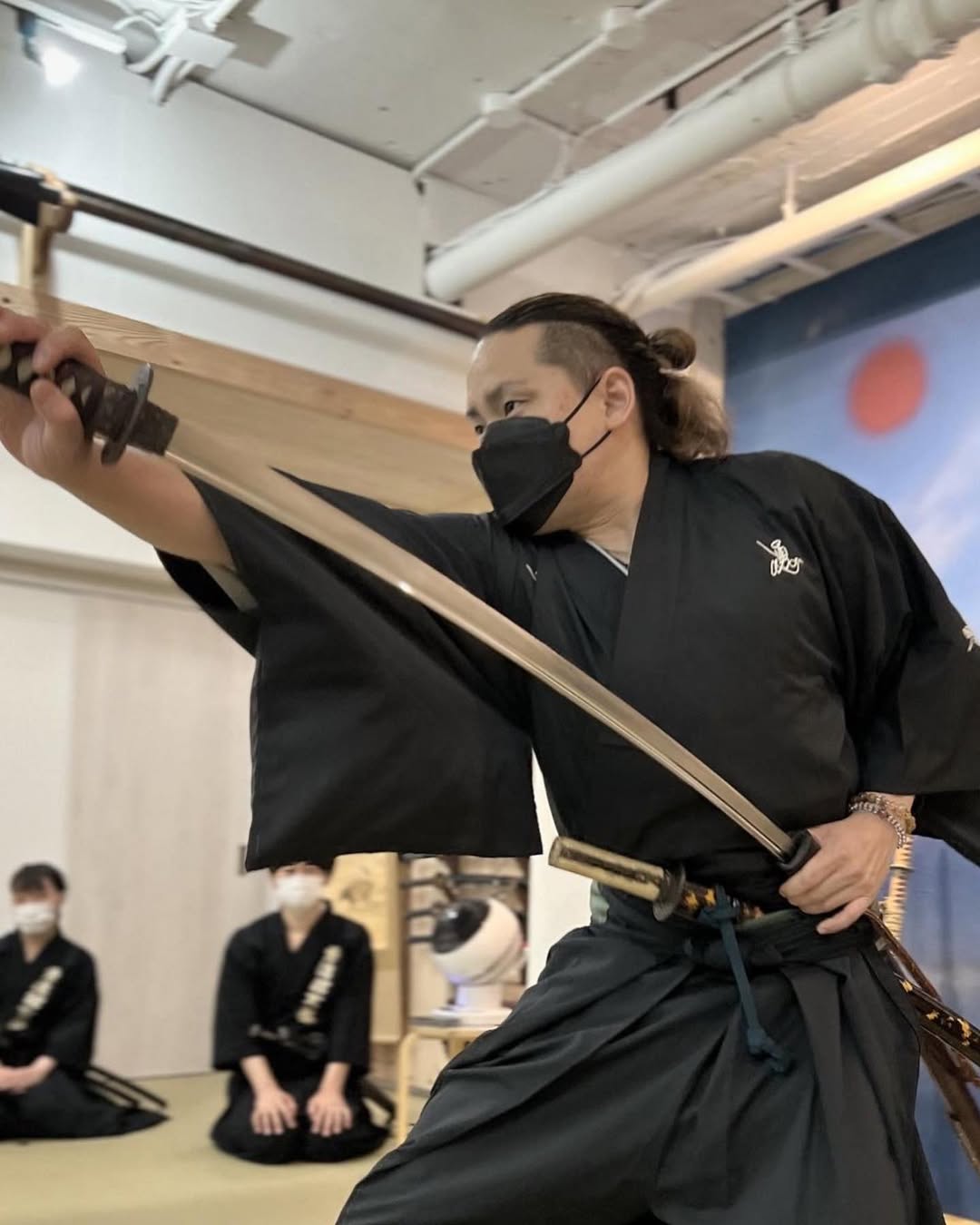
Iaijutsu / Iaido (居合術 · 居合道)
The art of drawing the sword. Iaido is the practice of responding to a sudden encounter — drawing, cutting, and resheathing the sword in a single, decisive sequence. At Yushinkan, every guest practices iaido fundamentals with a traditional iaitō (training katana built to the same shape, weight, and balance as a real sword).

Kenjutsu (剣術)
The art of swordsmanship — the broader system of cutting, posture, distance, and timing that the samurai once trained for combat. At our dojo, kenjutsu is studied as the technical foundation behind every form. We do not teach it as sport, but as the original martial art it was.
Tameshigiri (試斬術)
The art of test cutting — traditionally used to verify a swordsman’s technique on tatami targets. Where many modern Iaido schools train only in kata (forms) without ever cutting, Yushin-Ryu insists on test cutting as proof that the form contains real technique.
The Spirit of “Yumo Maishin” (勇猛邁進)
The name Yushin-Ryu comes from Yumo Maishin (勇猛邁進) — meaning “to advance with courage and resolve.” This is the spirit we bring to every session, and to every form we teach: not the empty repetition of movement, but technique grounded in centuries of practice, transmitted with intent.
Alongside the technique, we transmit what the samurai considered inseparable from the sword: 礼儀作法 (etiquette), 和の精神 (the spirit of harmony), and 感謝の心 (gratitude). Mind (心), Technique (技), and Body (体) are practiced together — never apart.
Where Yushin-Ryu Lives Today
Our home dojo is in central Kyoto. From here, the school has extended its presence to other historic centers of Japanese swordsmanship — and is beginning to share its tradition with the world.
- Kyoto (Yushinkan main dojo) — Our headquarters, where regular students train and where we welcome visitors from around the world.
- Tokyo — Affiliated training in the Kanto region.
- Iga-Ueno — Historical home of Japan’s ninja and samurai traditions.
- International outreach — Yushin-Ryu is beginning to share its tradition with serious practitioners abroad.
Recommended Reading
Article
Why We Are Called the Modern-day Musashi
Miyamoto Musashi and Yagyū Munenori — the founder of our own lineage — were contemporaries who never crossed swords. So how did a Yagyū-line dojo come to be known by Musashi’s name? A short history of the two-sword style and the swordsman who carries both traditions today.
Want to Step Inside This Tradition?
Yushin-Ryu is a living tradition — not a museum exhibit. Once a day, we open our Kyoto dojo to a small group of visitors who want to feel what this lineage is in their own hands, even just for ninety minutes.
Includes pricing, what’s included, FAQs, and direct booking
